Technologies to improve the reliability and safety of gas well operation
in gas production and underground storage
Effective, next generation solutions for the mitigation of sustained casing pressure (SCP) and surface annular gas flow (SAGF)
Thermogel — a proven polymer system for the elimination of uncontrolled gas migration channels in gas wells
Thermogel
A proven polymer system for the elimination of uncontrolled gas migration channels in gas wells
Effective, next generation solutions for the mitigation of sustained casing pressure (SCP) and surface annular gas flow (SAGF)
SCP and SAGF Issues:
risks and causes
Sustained casing and sustained annular can cause
uncontrolled gas releases, fires, and explosions.
Sustained casing pressure (SCP)
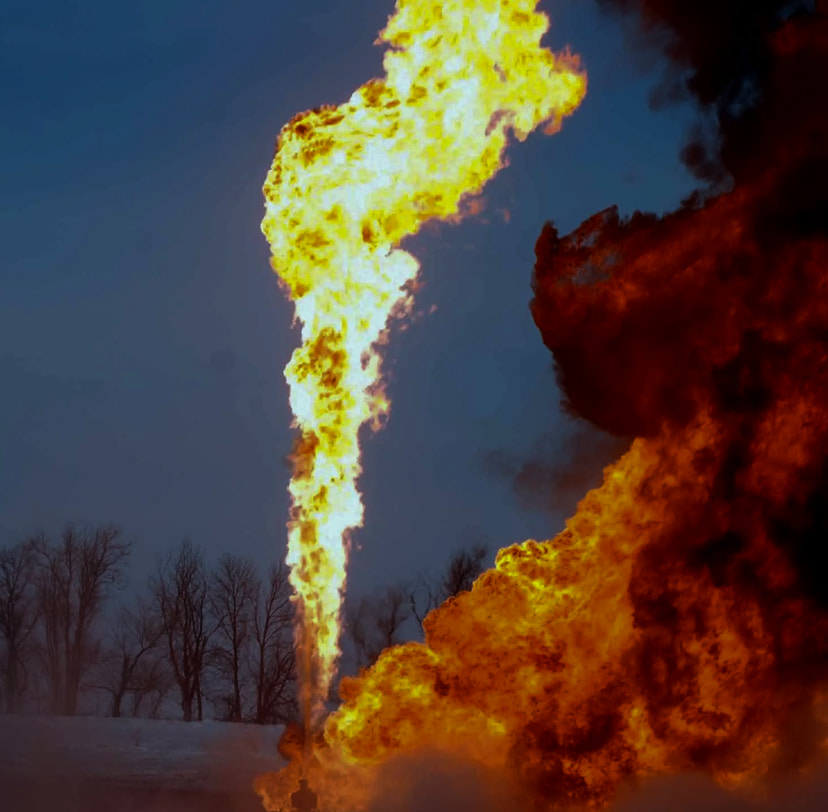
The development of a catastrophic situation in the form of an open, uncontrolled gas release from the seals of the wellhead (Christmas tree) caused by sustained casing pressure.
Sustained annular gas flow (SAGF)
An open, uncontrolled gas release at the wellhead as a result of sustained annular gas flow.
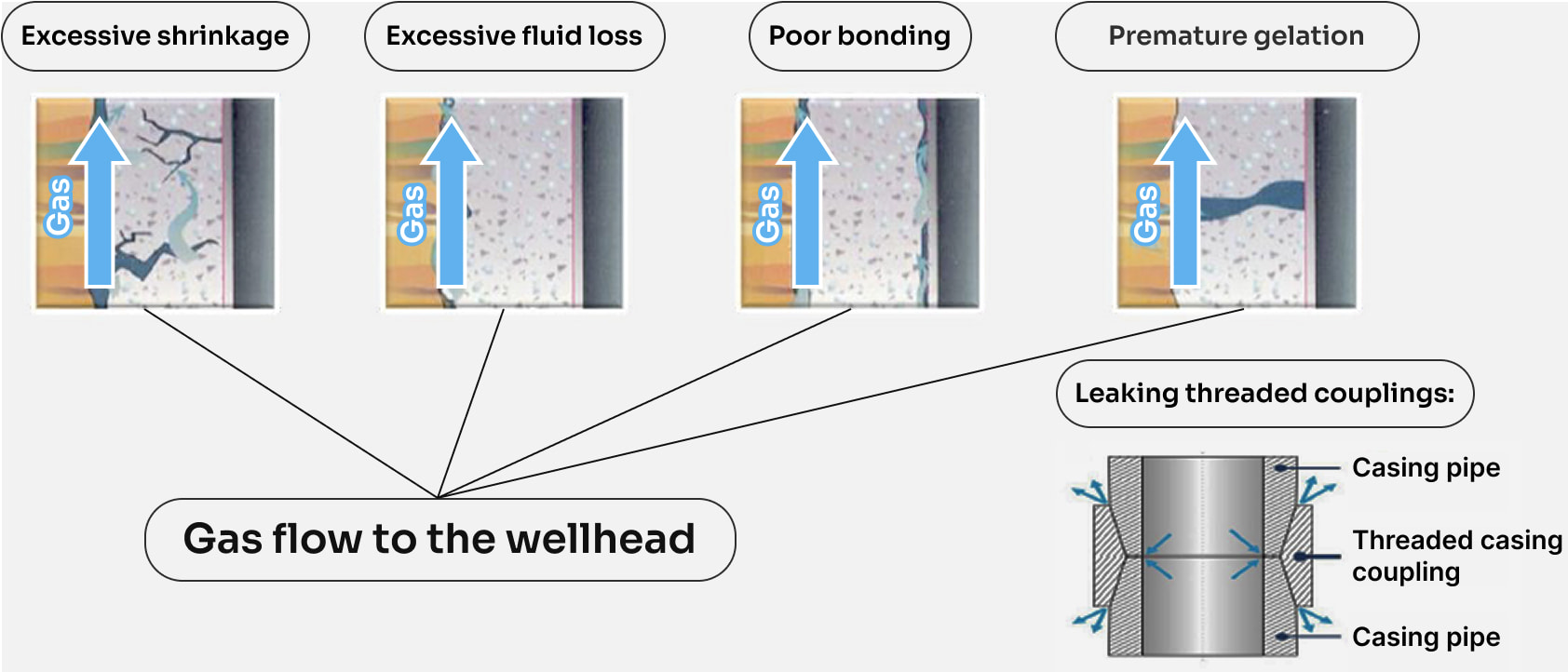
Poor cementing quality:
Causes of occurrence
- Violation of well construction or casing technologies
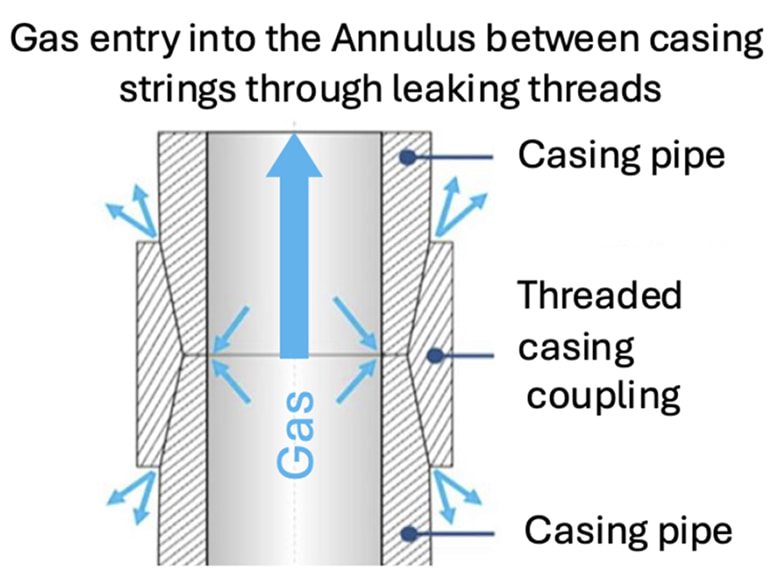
- Leaks in casing string threaded connections
- Leaks in wellhead seals
- Poor cement adhesion
- Premature gelation
Consequences
- Risk of accidents, including emissions
- The need for permanent security measures
- Environmental problems due to methane emissions
Thermogel: Innovative
insulation technology
UTEC is the exclusive manufacturer of the Thermogel polymer-based isolation compound.
The company possesses unique expertise and practical experience in applying Thermogel for the elimination of SCP and SAGF in gas wells.
Thermogel is a low-viscosity liquid reagent capable of rapidly transitioning into a viscoelastic state under certain conditions. It exhibits excellent adhesion, is chemically inert, and does not require any special technical equipment for application.
The technology is based on the sequential injection of two reagent solutions — the Thermogel polymer composition and a salt-based activator; The formulation easily penetrates fractured and porous zones and transforms into a viscoelastic state upon mixing.
Advantages of the Thermogel Polymer Composition:
Excellent
gas-blocking capacity
Low
implementation cost
Applicable in
10°C to +150°C
Easy
to apply
to apply
Long-lasting
sealing effect
Chemically
neutral and safe
neutral and safe
Solving SCP and SAGF problems
SCP Remediation
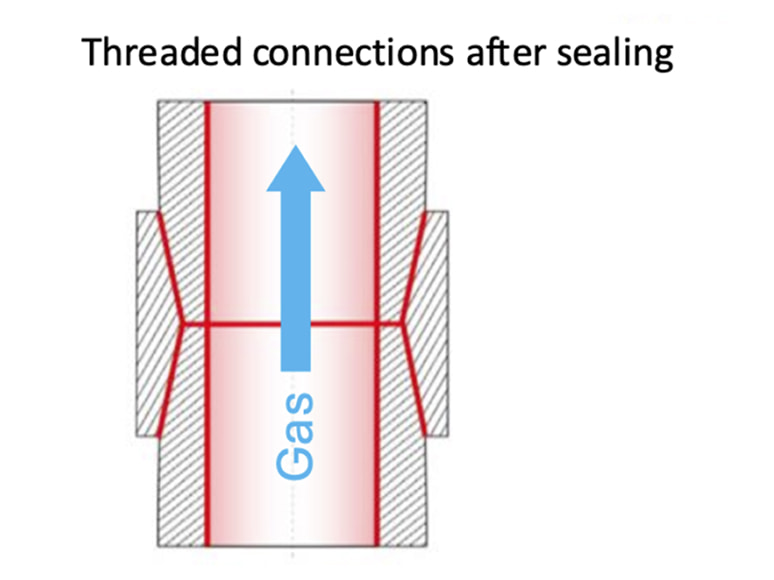
- Sequence of Technological Operations for the Prevention or Elimination of Sustained Casing Pressure (SCP) Using the Thermogel Polymer Composition
- The main method for eliminating or preventing annular pressure using the Thermogel composition is stepwise treatment of the annular space;
- Operations are carried out after well killing and isolation of the productive interval during workover operations;
- The shoe of the tubing string is placed at the lower part of the production casing, leaving the annular space open;
- The solutions of the salt activator and Thermogel are injected sequentially, with intermediate flushing, and move cyclically down the annular space.
- The process includes pauses and creation of overpressure to treat the entire interval from the wellhead to the tubing shoe.
SAGF Remediation
HOW THE TECHNOLOGY WORKS – SAGF REMEDIATION
Sequence of technological operations for the elimination of Sustained Annular Gas Flow (SAGF) using the Thermogel Polymer Composition
The core method involves injecting a polymer-based isolation compound under pressure through specially perforated holes into the outer annular space.
1. Preparation Stage
The well is killed, and the productive interval is isolated as part of a standard workover program.
Two perforation intervals are created in the middle section of the wellbore, spaced at least 100 meters apart.
Both are located in zones where cement is partially or completely absent, according to CBL/VDL log data.
Two perforation intervals are created in the middle section of the wellbore, spaced at least 100 meters apart.
Both are located in zones where cement is partially or completely absent, according to CBL/VDL log data.
2. Setting a Barrier
A bridge plug or cement plug is set below the lower perforated interval.
The annular space is opened to atmospheric pressure via a gas bleed-off line.
3. Equipment Deployment
A packer is run on tubing and set above the lower perforated interval.
The tubing shoe is positioned within or just above the lower perforation zone.
4. Protective Screen Installation (to shield the productive interval)
A salt-based activator solution is injected under pressure into the lower perforated interval.
This creates a chemical barrier to prevent downward migration of Thermogel toward the reservoir. The activator is secured with a small volume of cement slurry.
5. Injection of Isolation System
The packer is repositioned above the upper perforated interval. A sequential injection is carried out: activator solution → buffer fluid → Thermogel polymer composition.
6. Final Fixation
To complete the treatment, a small volume of cement slurry is injected into the upper perforated interval. This provides additional fixation of the isolation material and ensures long-term sealing between the annular and outer annular spaces.
Possible technological risks
and mitigation measures
Risk 1:
Potential premature mixing of the system’s components
Possible mixing of activator and Thermogel in the tubing or annulus, leading to gel plugs and blocked flow channels
Mitigation measures:
For SCP:
A full-volume flush of the tubing and annular space is performed between injections of the activator and the polymer composition. This completely eliminates the risk of reagent mixing in the annular space.
Across more than 100 applications of this method, no cases of annular blockage have been recorded — even in wells where subsequent workover operations (WO) were performed.
For SAGF:
The components are injected into the perforated interval with separation by a buffer fluid (technical water) in a volume of at least 50% of the tubing capacity.
This reliably prevents mixing inside the tubing. The annular space is isolated by a packer.
Risk 2:
Ingress of reagents into the producing formation
Ingress of reagents into the producing formation with potential formation damage (plugging).
Mitigation measures:
For SCP:
All treatments are carried out after the well has been killed and the producing interval isolated. This eliminates the risk of reagent penetration into the reservoir.
For SAGF:
Thermogel is injected into the middle section of the wellbore; the volume is insufficient to reach the productive interval.
Additionally, a salt-based activator is pre-injected through specially made perforation holes located above the producing interval as a protective barrier.
Even if Thermogel were to move downward, it would be blocked by the previously placed activator. Across more than 15 operations, no incidents of reservoir plugging have been observed.
Experience with
Thermogel Technology
Between 2010 and 2025, the following operations were successfully carried
Isolation of production casing couplings to eliminate SCP— 81 wells
Injection of isolation composition into the outer annular space to eliminate SAGF — 8 wells
Isolation of production casing couplings to eliminate SCP — 17 wells
Injection of isolation composition into the outer annular space to eliminate SAGF — 2 wells
Isolation of production casing couplings to eliminate SCP — 9 wells
Injection of isolation composition into the outer annular space to eliminate SAGF — 6 wells
Alternative Technologies
vs. Thermogel Technology
Elimination of SCP by Sealing Threaded Couplings in the Production Casing:
There are no alternative technologies available for this type of remediation.
Elimination of SAGF by Preventing Gas Migration Through the Outer Annular Space to the Wellhead:
An alternative technical solution to SAGF remediation involves milling out the old production casing (as well as the technical casing and surface casing), followed by running new strings and recementing them.
Key drawbacks of this method:
- Extremely high cost— approximately 10 to 15 times more expensive than SAGF remediation using Thermogel.
- No guarantee of success— due to the high risk of poor-quality cementing, SAGF may still reoccur.
CONTACTS
UTEC – Universal Technological Engineering & Consulting LLC
Registration Nr.
LV40203496170
Company address:
Osu iela 18, Mezares, Babites pagasts, Marupes novads. LV-2101, Latvia
Email: